


You’re probably wondering how to attract U.S. clients as an international clinician or other healthcare professional if you’re reading this. Attracting these patients is much easier than you might think, but requires changing how you think about your practice.
The US wellness marketing opportunity for clinicians is bigger than it has ever been, and it's currently valued at about $2.1 trillion, which works out to approximately $6,293 per patient annually. The U.S. wellness market is currently about double the size of China’s market, despite its population being only about a fifth of China's population.
One big mistake international practitioners make when trying to tap into the U.S. market is believing you need to replicate a U.S-style clinical practice to funnel patients your way.
You don’t have to do that. What you need to do is understand what English-speaking patients are looking for and meet them where they currently are.
Why the US Wellness Market Is Growing (and What That Means for You)
The reasons why the US wellness market is growing aren’t complicated. Americans currently spend more on their health than they’ve ever done before. The U.S. consumer healthcare market grew by 3% in 2025 to $107 billion, surpassing overall retail growth. Consumers are shifting toward being proactive regarding their health and are increasingly embracing holistic well-being, favoring prevention and self-directed care over reactive treatment.
That's where you come in.
The US wellness market for foreign practitioners is hungry for qualified healthcare professionals. Recent surveys show that 71% of patients in the U.S. now search for therapists and physicians online before booking their first session. Your potential clients are out there right now, reading articles and trying to figure out how to get optimal care.
What English-Speaking Patients Actually Search For
Understanding what English-speaking patients search for is your competitive advantage that positions your practice to tap into the U.S. wellness market. Most international clinicians assume they need to compete on price or convenience, but that's not necessarily true.
US patients search for solutions to specific problems they have. They type things like:
- Why am I always tired no matter how much I sleep?
- Natural treatment for hormonal imbalance
- Functional medicine doctor for autoimmune issues
- How to fix brain fog naturally
Notice what's missing? They're overwhelmingly not searching for "international therapist" or "clinician in Colombia" as this typically is not a concept on their radar. They're searching for answers to their problems. Getting U.S. patients to utilize your services starts with appearing in search results, even if your website is not written in English.
How to Build Credibility Without an English Website
This is where South American clinicians especially shine. Building credibility without an English website starts with being visible.
Instagram is your secret weapon, and many of the South American clinicians I work with already use Instagram effectively. The key to increasing your website’s visibility is adding niche keywords within English-language materials that appear in Google search results, using relevant hashtags, posting educational content in both languages, sharing patient testimonials (with permission), and showing your expertise through video content.
You don't need a full English website to start. You need:
- A professional Instagram presence with clear descriptions of what you offer
- Educational posts that answer the questions US patients are asking
- Consistent posting that builds familiarity and trust
- Direct messages that convert – when someone reaches out in English, respond in English
[Related: Marketing for Doctor's Offices: Make a Memorable Brand in Medical Care]
Cross-Border Telehealth for Practitioners: The Smart Approach
Cross-border telehealth for practitioners exists in a legal gray area. U.S. therapists are licensed at the state level, and in most cases, a clinician must be licensed in the state where the patient is physically located.
But here's the workaround that actually works: offer educational courses and coaching services rather than clinical advice.
This is a smarter business model. You're not practicing medicine across borders. You're educating. You're coaching. You're sharing your expertise in a way that doesn't typically require a US license.
Here's how the funnel works:
- Free educational content: Webinars, TikTok video clips from webinars, Instagram posts, blog articles
- Paid educational courses: Deep dives into specific topics like "Nutritional Approaches to Hair Loss" or "Understanding Thyroid Health"
- In-person care: If/when patients want more, they travel to you. I’ve had some international clinicians say an education approach would never work as they focus on in-person procedures; however, revenue from an educational line of virtual products like courses is increasingly becoming popular in the U.S., even for aesthetics providers. This includes patient education and education to other clinicians. Additionally, even those clinicians who routinely offer virtual services–such as psychologists–have found that an educational approach with a focus on community led to their students wanting more, such as an in-person event hosted in Colombia or Spain or France.
This educational approach has another benefit. For example, many US patients are aware of the hair transplant industry in Turkey. Creating awareness that similar services exist in Colombia, with a much shorter flight from the U.S., could be a game-changer. A South American hair transplant specialist can funnel some of these patients their way by offering a closer, more accessible option.
The Funnel That Actually Works
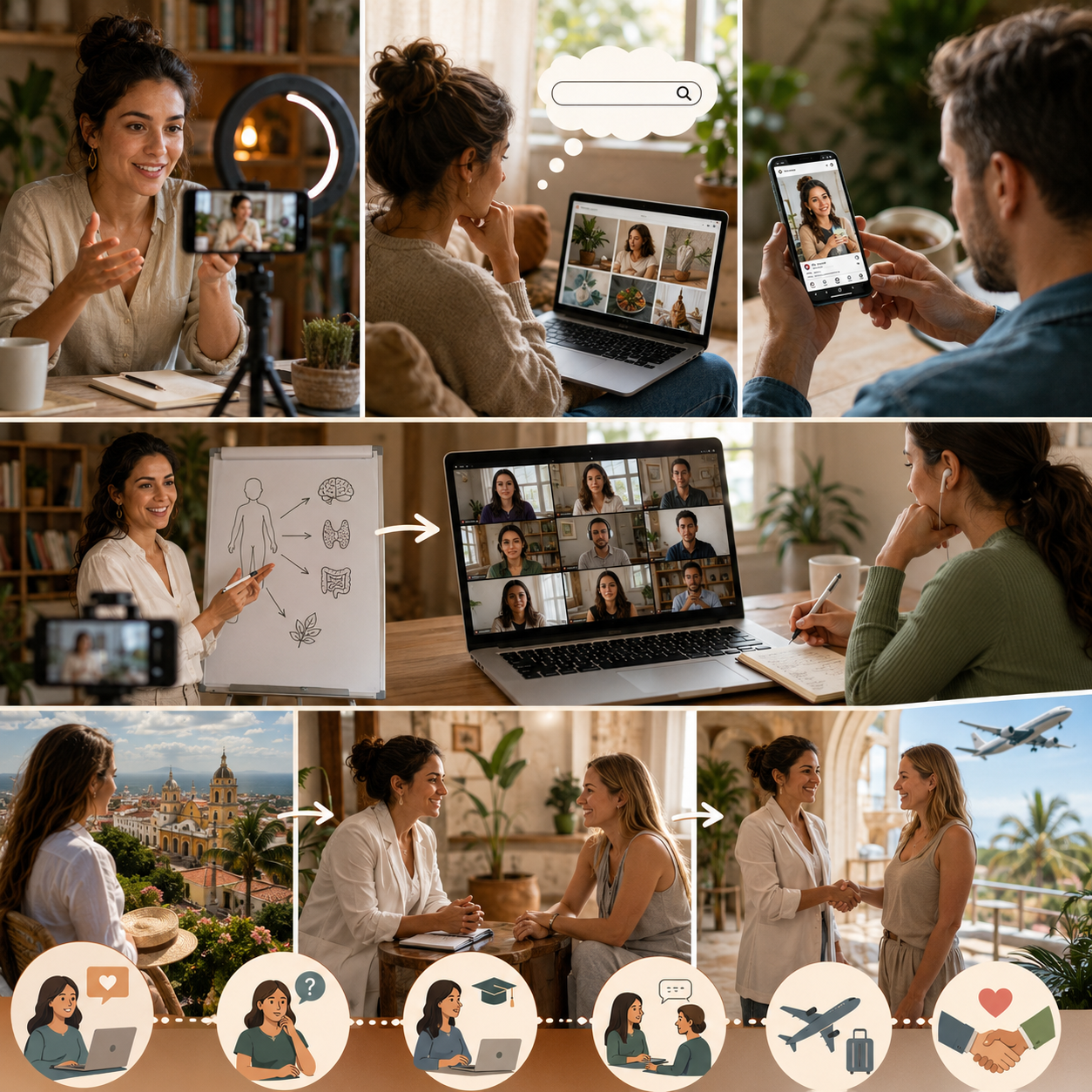
Here's what I've learned from working with clinicians in Colombia, Portugal, France, and the UK: Attracting U.S. clients as an international healthcare professional requires a staged approach.
Stage 1: Awareness
Create educational content in English. Answer the questions US patients are actually searching for. Use social media platforms like Instagram, LinkedIn, and Facebook, plus your website to build visibility.
Stage 2: Education
Offer paid courses and workshops. These monetize your expertise and build trust. Your U.S. patients will appreciate that you're a trained psychologist, even if your degree is a Master's in Psychology rather than a US-style PhD. That's actually a strength. You understand psychological theories and frameworks and can use them to teach people. Therapists in the U.S. tend not to be psychologists and often have a Master’s degree in Social Work, which means they may have learned some therapeutic strategies, but they often do not understand psychological theory and frameworks in depth in a way that they can provide patient education on psychology alongside psychotherapeutic interventions.
Stage 3: Conversion
Some patients will want more. They'll travel to you for in-person care. Others will refer colleagues and friends. This is where medical tourism becomes a natural next step, not the starting point. And tourism does not necessarily have to be medical tourism. The event industry is large in the U.S., and many people get excited about traveling to large wellness or personal development events. International psychologists can provide educational courses and coaching virtually and note what needs emerge, such as their students potentially being interested in a large annual event in-person in the psychologist’s home country.
Your Next Step
The US wellness market opportunity for clinicians is real, and you don't need to figure out how to tap into it alone.
I'm running repeated sessions of a free introductory webinar called The US Wellness Market: An Opportunity for International Clinicians. The next event is on Saturday, September 5th. In our last event, clinicians attended from three different countries. This webinar is designed for health and wellness professionals outside the United States who understand at least a minimum of conversational English and are curious about whether—and how—they could serve the US market.
What you'll learn:
- Why the US wellness market is growing and what that means for you
- What English-speaking patients actually search for
- How to build credibility without a full English website
- The legal and practical realities of cross-border work
- A clear, staged approach to attract US clients
Date: Check the link for upcoming sessions.
Location: Online (Zoom)
Cost: Free
👉 Register for the Free Webinar
If you're already aware of the massive opportunity the growing U.S. wellness market represents and are ready to take action, my paid workshop, Building Your Cross-Border Business in the US Wellness Market, is the next step on Saturday, September 12. In 90 minutes, we cover the practical steps you can use to start testing the market.
👉 Register for the Paid Workshop
Don't Let the Market Pass You By
Learning how to attract US clients as an international clinician requires understanding what patients are searching for, showing up where they're looking, and building trust through education.
The $2 trillion US wellness market is waiting for you. The question isn't whether you can serve it. It's whether you'll start.