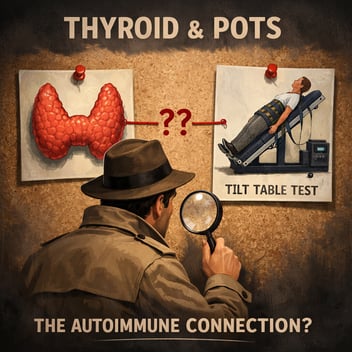



There is a tendency in conventional thyroid care to collapse an extraordinarily complicated biological system into a simple decision tree. TSH is high. Therefore, the patient is hypothyroid. The treatment is levothyroxine. Medication taken: treated. Medication declined: untreated.
My body has not followed that decision tree, and the more closely I look at my own labs, the less that framework seems to fit.
I have been euthyroid then hypothyroid then euthyroid then hyperthyroid and now hypothyroid (all largely being influenced by quantity of iodine in my diet). I have had virtually no measurable thyroid-stimulating hormone (TSH), and I have had TSH jump from about 20 to 30 over two months. I have watched my TSH fall by half on its own, without medication, and climb back up again. Even at my highest TSH readings, my free T4 has stayed inside the laboratory reference range. My PCP has told me she's never seen someone with a TSH this high who still has a normal free T4 (FT4). I don't find that discouraging. I find it like a locked door with a key sitting somewhere in the room.
TSH Is a Signal, Not the Whole Story
TSH and free T4 don't measure the same thing. TSH is the pituitary's request. FT4 is what the thyroid actually delivers in response. When TSH is extremely elevated but FT4 is still landing inside range, that tells me the thyroid is straining, not that it has stopped working. The question that actually interests me isn't "how do I make the TSH number go down." It's "what is making my thyroid need to work this hard to hold FT4 where it is?"
I've been tracking ferritin, TSH, and FT4 together rather than in isolation, and running basic correlations across the results. Across ten recent data points, ferritin and TSH show a moderate negative correlation, roughly -0.6. Lower iron stores loosely track with higher TSH. Ferritin and FT4, by contrast, show essentially no relationship at all, close to zero.
I want to be precise about what that does and doesn't mean. A moderate within-person correlation across ten points is a hypothesis generator, not definitive proof of anything. My own data undercuts a simple version of the story too: at the exact same ferritin level of 12, I've recorded a TSH of 21.7, a TSH of 10.6, and a TSH of 11.7 within a few months of each other. Ferritin sitting still while TSH swings that much tells me ferritin isn't the only lever being pulled. The likeliest culprit for that particular swing is iodine timing. One low-TSH, high-FT4 point landed during a stretch when I was eating more iodine-containing cheese, and iodine substrate can move the needle on its own, independent of iron status.
So the honest picture is layered. A slow-moving iron-related baseline sits underneath faster iodine-driven noise on top of it. Not one variable. At least two, tangled together.
Where the Physiology Actually Points
Thyroid peroxidase (TPO), the enzyme that does the actual work of building thyroid hormone, is a heme-containing, iron-dependent enzyme. That part isn't controversial; it's basic biochemistry. What's less settled is how much that matters clinically. Animal studies have shown that iron-deficient rats have meaningfully reduced thyroid peroxidase activity and lower circulating T3/T4, independent of the reduced food intake that also comes with iron deficiency. Human observational studies echo this at a population level. Specifically, people with iron-deficiency anemia tend to show higher TSH and lower free T3/T4 than iron-replete controls, and some studies report a fairly strong negative correlation between hemoglobin and TSH.
The interventional evidence, whether correcting iron alone actually moves TSH, is genuinely split. One trial found iron replacement by itself, without levothyroxine, didn't significantly change TSH in patients with coexisting iron deficiency and subclinical hypothyroidism. An earlier, smaller trial found the opposite: iron alone lowered TSH and raised FT4. Case reports exist at the extreme end too, including a documented case of a patient with a TSH of 870 and a ferritin of 2, whose hypothyroidism was attributed to severe iron deficiency, although she also received transfusion and levothyroxine at the same time, which makes it hard to credit iron alone.
I don't think the field has settled this. I think that's exactly why my own longitudinal data is worth collecting.
Where My Iron Has Actually Been Going, and Why I Can't Just Supplement My Way Out
This is the part of my history that I think gets lost when a lab value gets treated as a starting point instead of an outcome. My ferritin didn't drop suddenly. It became inconsistent and then steadily fell, and the timing of that decline lines up with a period when I could no longer eat sprouted grain toast in the quantities I used to. That toast was doing real work in my plant-based diet, sometimes contributing close to 20 mg of iron a day. When I lost the ability to tolerate it in those amounts, I lost my main functional iron source, not a minor one.
Supplementation hasn't been a workable substitute. I've been unable to tolerate iron supplements at all. Most recently, even a dose as small as 2 mg caused significant adverse effects. That's not a minor sensitivity threshold. It rules out the standard first-line fix that most clinicians reach for automatically, the same way levothyroxine got reached for automatically on the thyroid side.
So the plan isn't "take more iron." It's narrower and more specific: trial reintroducing sprouted grain toast, gradually, and watch what happens to ferritin, serum iron, transferrin saturation, hemoglobin, platelets, and thyroid markers as I do. If a food source I know I can tolerate can move the numbers where a 2 mg supplement cannot, that itself is useful information, not just about my iron status, but about how differently my body handles iron delivered through food versus an isolated supplemental dose.
What About the Iodine History?
None of this happens on a blank slate. I went through a well-documented iodine-induced hypothyroid episode, followed by reducing iodine intake and becoming euthyroid. After this, I added more iodine back to my diet but too rapidly, and accidentally swung into hyperthyroidism that rapidly escalated within three months to hit a free T4 of over 6 ng/dl and a TSH that eventually was essentially suppressed to nothing. After lowering my iodine intake again, getting my free T4 back within normal range, and seeing my TSH re-surface, I have struggled to slowly increase my iodine intake again back to normal levels. Patients tell me at times that they have an iodine allergy or their body repels iodine, and I have read a similar case of iodine-deficiency hypothyroidism due to iodine avoidance from it making the case study participant sick. Only years later did he try to consume iodine again after a very limited diet. Interestingly, in a familiar pattern, the endocrinologists accidentally fixed his hypothyroidism and then promptly accidentally allowed him to go into hyperthyroidism by failing to monitor him more regularly and consult with him on adding iodine-rich seafood to his diet in addition to iodine supplementation as he became less sensitive to iodine and his goiter decreased in size from initial iodine supplementation only. The case study ends here so we are left with the mystery of whether he ever got help with his hyperthyroidism.
For me, I had no established pathway as more than 16 mcg of iodine a day in the form of eggs post-hyperthyroidism made me feel nauseous. I could smell iodine on me everywhere for months if I ate more than that, the sensation of it burning in my tears, coming out in my sweat glands. There are typically disclaimers that such sensations are impossible with how the body handles excess iodine, but all I know was that my body seemed aggressively anti-iodine when my TSH finally re-surfaced whereas I had not experienced such problems eating 60 mcg/day of iodine with a free T4 of 1.8 and my TSH still not detectable.
It took months to reach a point where the sensation of iodine purging had ended and I started slowly increasing iodine in my diet again, approximately 4 mcg at a time in the form of fortified eggs. The eggs seemed to be a more consistent source as I also used aged feta cheese for B12 at times that caused what felt like hyperthyroidism spikes and matched up with free T4 jumps on my lab work. These episodes would often last about 12 hours and start in the afternoon as I felt myself moving toward vertigo until I would have such an extreme vertigo episode for hours that I would vomit anything and everything in my stomach and could not close my eyes for feeling the world spinning around me. At one point, I was in the middle of such an episode when a U.S. endocrinologist who had seen my work messaged me on Linkedin to ask me to hop on a call and pay him to hear my story. Apparently, he was not aware of which way the money flowed in commercial engagements with paid speakers providing information. I provided a response that was indignant but still professional in the midst of a spinning room.
After several months, I felt that the purge had ended and that I was becoming deficient in iodine. Again, these are all sensations that I am reporting and not well-known scientific processes. I finally was able to start slowly increasing my iodine intake, often feeling a "slam the brakes" feeling at each small change before I felt my metabolism pick up again, I would feel hungry through the day, my dry skin would improve, and I would lose some weight. Only for this to last until I felt like the earned momentum was again petering and I'd have to repeat the process. The metabolic symptoms didn't perfectly match up to my thyroid numbers, although interestingly they did match up more with metabolic markers like blood CO2.
In this current moment, I have worked hard to slowly increase my iodine and have finally reached approximately 100 mcg/day, below the 150 RDA, but above the extremely low original intake of 16 mcg/day. Again, none of these numbers are a recommendation. They are simply the ceiling that my body allowed without vomiting food back up which unfortunately took precedence over anything a doctor or textbook or guideline said if my body refused to accept recommendations.
However, more recently, my TSH has jumped up from about 20 to 30 over eight weeks with my free T4 still in low-normal range. And I am currently exploring more to the picture than just iodine deficiency. I have had low ferritin before but never been anemic. I improved my iron while becoming hyperthyroid as I was over-eating seafood as a more tolerable source of heme iron but unfortunately too iodine-rich. I was also consuming extraordinary amounts of food at the end due to significant hunger. My recovery period during the hypo-rebound after hyperthyroidism consisted of a greatly reduced appetite and greater food sensitivity from inability to eat sardines as a source of heme iron to struggling to tolerate sprouted grain toast that I used to eat in high quantities at 2 mg of non-heme iron per piece. I am now considering the iron element in the thyroid picture here.
The Cardiovascular Risk Conversation Needed a Second Half
In a recent conversation with my PCP, she raised cardiovascular risk as a reason to again reconsider levothyroxine, the same medication that had already caused me a week of significant, disabling side effects at a single dose. What she didn't do was frame that risk as relative rather than absolute, and she didn't take the next step of actually measuring my individual risk markers. I had to ask for that myself, specifically requesting a lipid panel be added to my next round of bloodwork.
That distinction matters enormously. Subclinical hypothyroidism has been linked to increased cardiovascular risk in multiple meta-analyses, but the size and even the statistical significance of that association vary a lot depending on the population studied and the TSH threshold used. One pooled analysis found a relative risk around 1.7 for coronary heart disease at a TSH cutoff of 10 or higher, but with a confidence interval wide enough to include no effect at all. Other individual-patient meta-analyses found increased events mainly at TSH of 10 or above, and increased mortality mainly at TSH of 7 or above, both thresholds I've been well past for a long time. So there is a real, published association. What isn't established nearly as well is what that relative risk means in absolute terms for someone like me specifically.
I am 37 years old. I don't smoke. I don't drink. I don't have diabetes. I have no family history of heart disease. The standard cardiovascular risk calculators used in clinical practice, the Pooled Cohort Equations, aren't even validated for someone my age; they're built and calibrated for ages 40 to 79. That alone should have been part of the conversation. Using the closest comparable published estimates for low-risk women with optimal risk factors in their early 40s as a rough stand-in, baseline 10-year ASCVD risk in that group is typically under 1%, often well under it. Doubling a number that small, even taking the most alarming relative-risk figures from the subclinical hypothyroidism literature at face value, moves an absolute risk of roughly half a percent to something still under 2%, not a dramatic jump in real terms. I want to be honest that this is an illustrative estimate built from the closest available published low-risk figures, not a personalized calculation, since no validated tool actually covers my age bracket. But that's exactly the point. A vague statement that risk is "greater" without that context reads very differently than "your absolute risk moves from very low to still very low." If we are addressing risk-versus-reward and the risk of dying tomorrow if I'm not medicated with synthetic T4 immediately is extremely high, I would be willing to take levothyroxine as an emergency measure. But that's why it's important to talk about risk in genuine terms. If the relative risk is much lower, I have demonstrated that levothyroxine does not work well for my body, and my numbers point to a thyroid that is functioning but needs significant stimulation from the pituitary releasing TSH, the question remains why? Especially for someone who has had a lifetime of euthyroidism and even during thyroid imbalances has demonstrated periods of euthyroidism when iodine excess and deficiency were not at play. The question has not been answered first of what thyroid status could be achieved if I were not in a malnourished state due to a high level of sensitivities affecting food and supplement intake.
I do have a family history of high cholesterol, so this wasn't a case of dismissing the topic of cardiovascular risk. But this is a unique family history of high cholesterol as our cholesterol profile runs with extremely high HDL and normal triglycerides. I've corrected elevated markers before, not with medication, but by identifying and reducing my overconsumption of peanut-based products and otherwise improving my overall omega-3 to omega-6 ratio. As an aside, no dietitian or physician had ever mentioned that connection to me before. I'd only ever been offered two responses: a push toward statins, or reassurance that I was fine because my risk factors were low and my HDL was high. Neither response actually looked at the mechanism or gave me something I could act on. Finding and fixing that dietary imbalance myself is part of why I want my actual numbers measured again now, rather than reasoning from a generic risk statement.
Why "Untreated" Doesn't Fit My Case
I tried levothyroxine. One dose left me dysfunctional for roughly a week. That's part of my medical history, and it belongs in the treatment conversation as much as the TSH number does. I'd rather describe that outcome accurately than dismissively: the medication did not benefit me. Calling it a failure implies the problem was mine. Calling it something that didn't work for my particular physiology leaves room for the fact that treatment isn't only what happens pharmaceutically. Investigating a mechanism, correcting a nutritional deficiency through food when supplements aren't tolerated, and monitoring longitudinally are all still treatment, just not the kind that fits neatly into a prescription pad.
There's also a scientific cost to reaching for levothyroxine before finishing this investigation. If iron deficiency is genuinely contributing to my impaired thyroid synthesis, correcting iron and starting exogenous T4 at the same time would make it nearly impossible to tell which intervention did what. TSH could normalize because the pituitary sees more circulating hormone from outside, while the underlying iron-dependent physiology stays exactly as broken as it was. The lab values would look solved. The mechanism would still be a mystery.
I don't want to hear about "untreated thyroid disease" as I'm the one inputting my lab values into SPSS and running analyses, researching more information, reviewing research literature, and forming hypotheses to test and then see the impact in my bloodwork. The reality is that I'm the only one treating my thyroid condition and managing my team of medical providers. The word "untreated" overlooks the hours of feeling flushed, vomiting, shaking as my heart raced in tachycardia from trying a new food or supplementation source. The reality is that our system is less developed than is needed to support care in cases like mine.
The Experiment I'm Running
If reintroducing sprouted grain toast lets me rebuild iron status through a route my body actually tolerates, several things become measurable rather than theoretical. Does ferritin rise? What happens to serum iron and transferrin saturation, values I don't have yet for this current period, and the single most informative panel I can add right now? Does the anemia keep improving? What happens to my platelet count as iron deficiency, per the corrected understanding I've reached, hopefully starts actually resolving instead of just continuing to drive reactive thrombocytosis? Does FT4 change? Does TSH, eventually, follow? And what does my lipid panel actually show, now that it's been ordered?
Maybe none of the thyroid markers move. That result would tell me something too. It would mean the iron hypothesis explains less of my picture than I currently think, and would shift weight back toward autoimmune or purely iodine-driven explanations I haven't ruled out yet, since I still don't have TPO or thyroglobulin antibody results either.
That's the difference between declining treatment and running an investigation. I'm not avoiding the TSH of 30. I'm asking what's producing it, using my own body and my own tolerated food sources as the intervention I can actually test, and being as willing to have my hypotheses corrected by the data as I was with my initial read on the platelet count.
Disclaimer: I'm not a medical professional, and nothing in this piece is medical advice or a diagnosis. It's a personal account of my own lab trends, hypotheses I'm exploring with my care team, and background research I've read, not a recommendation for how anyone else should interpret or manage their own thyroid, iron, or cardiovascular risk. The cardiovascular risk figures discussed above are illustrative estimates based on published low-risk reference populations, not a personalized calculation, since standard risk calculators aren't validated below age 40. Individual physiology varies enormously, correlation in a single person's data cannot establish causation, and anyone with abnormal thyroid, iron, or lipid results should work with a qualified clinician on their own evaluation and treatment plan.