


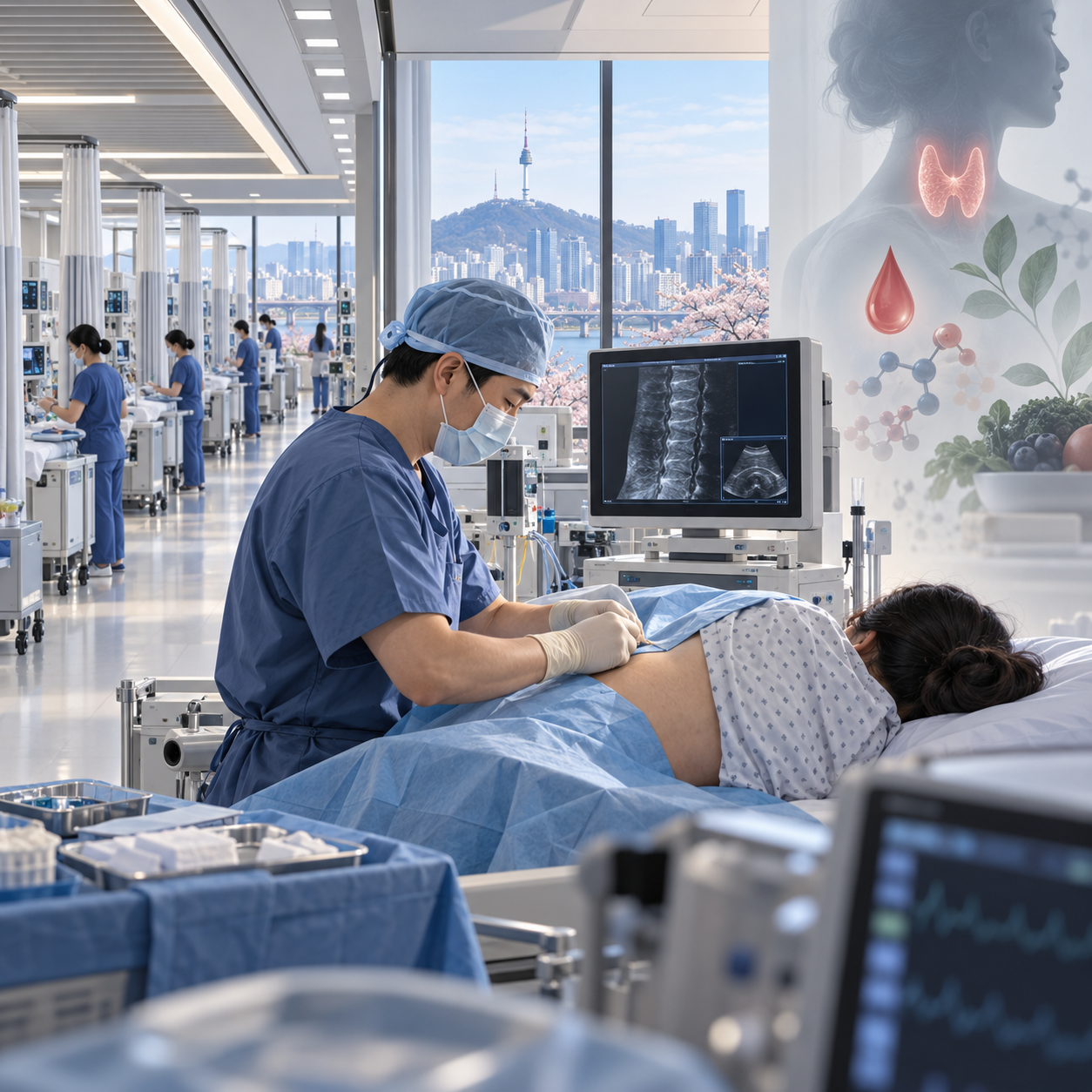
What makes analyzing international health systems so worthwhile? Each nation masters distinct challenges while retaining its own blind spots. Among these, South Korea and Colombia serve as particularly illuminating case studies.
This three-part series explores what the U.S. healthcare system can learn from South Korea and Colombia, and how these nations can learn valuable insights from each other.
- Part 1: South Korea's regulated private market and how price caps create unexpected expertise through volume.
- Part 2: Colombia's generalist training model and why seeing the whole patient matters.
- Part 3: What each system can teach the other, and why cross-border collaboration might be the future of healthcare.
Here are some interesting statistics that paint a clearer picture of what the healthcare system in South Korea looks like:
- The life expectancy in South Korea is 83.5 years, 2.4 years above the Organisation for Economic Co-operation and Development (OECD) average.
- The country's preventable mortality rate stands at 106 deaths per 100,000 people, well below the OECD average of 145 per 100,000.
- South Korea has 12.6 hospital beds per 1,000 population, more than triple the OECD average of 4.2 per 100,000.
- 69% of Koreans are satisfied with the availability of quality healthcare, a little higher than the OECD average of 64%
Though striking on first glance, the system's operational core is fundamentally shaped by its financial framework.
The Regulated Private Market
South Korea has universal National Health Insurance, and most providers, including privately owned hospitals and clinics, operate inside it. The government negotiates and regulates a national fee schedule for services covered.
This creates a fascinating dynamic: low unit prices + high procedural volume = expertise through repetition.
For example:
- A lumbar epidural block reimburses around ₩38,040 (~US$27).
- A cervical or thoracic epidural block reimburses ₩64,330 (~US$46).
- Fluoroscopic epidurography reimburses ₩122,120 (~US$88).
Compare that to U.S. pricing, where the same procedures can cost thousands of dollars.
Korea attracted 2.01 million medical tourists in 2025. These foreign patients spent an estimated 3.3 trillion KRW (about $2.2 billion USD) on medical tourism. That's a 144% increase from the revenue medical tourism generated in 2022. Also, these medical tourists and their companions spend a total of 12.5 trillion KRW ($8.4 billion USD) while in South Korea.
The largest share of foreign medical spending (62.9%) went for dermatologic care, but the numbers reflect a broader trend: Korea has become a global healthcare destination.
What South Korea Gets Right
South Korea’s regulated pricing model produces unexpected benefits. Korea’s anesthesiology and pain medicine field has maintained broad control over epidural interventions, likely due to the absence of a substantial reimbursement gap between procedures. An epidural blood patch (EBP), a technique that involves injecting autologous blood into the epidural space to patch a CSF leak, remains an integral component of their clinical toolkit.
This differs from other countries where neuroradiology has largely taken over epidural blood patching as the next step after diagnoses based on imaging, despite neuroradiology having less procedural experience with epidurals than anesthesiology.
The epidural blood patch is considered the gold-standard treatment for patients who fail conservative treatment for post-dural puncture headache (PDPH) and spontaneous intracranial hypotension.
Studies indicate that 67% of patients experience lasting symptom relief after receiving repeated EBPs. Furthermore, a 2026 case series reported complete symptom resolution in 77.8% of cases.
South Korean pain anesthesiologists can accumulate enormous numbers of epidural procedures because the economics demand volume. They build their practice performing hundreds of epidurals, blocks, and related procedures. A CSF-leak patient then benefits from an operator whose hands have performed that epidural maneuver thousands of times.
What South Korea Misses
Despite South Korean clinicians excelling at patient interviewing and procedural care, something was missing from my personal experience there. No one evaluated my nutritional status for vitamin B12, iron, or other micronutrients. My thyroid function wasn’t assessed either. Today, I know all three factors substantially affect my skin and overall health.
Even the most thorough patient interviews and skilled procedural execution remain incomplete when key endocrine or nutritional factors are left unexamined.
During my dermatology treatment in Korea, oral doxycycline caused significant dizziness. When I was back in the US, I tried an older antibiotic, ampicillin, which eventually worked far better. That reinforced an important lesson that medicine must remain individualized, and an older treatment can sometimes be the better choice for a particular patient, regardless of how sophisticated newer options look.
The Real Question
Instead of debating which global healthcare system reigns supreme, I focus on targeted inquiry: Where does the United States fall short, which nations are addressing those specific gaps effectively, and what insights can we extract from their approach?
U.S. health spending reached $5.7 trillion in 2025, approximately $14,781 per person. The average American family of four now spends $35,119 annually on healthcare. These figures represent total healthcare costs, including employer and employee contributions as well as out-of-pocket spending. Meanwhile, Korea's health expenditure per capita is $3,255.
The U.S. spends more and gets less. Korea spends less and, in some areas, gets more. The question isn't whether one system is "better"—it's what each can teach the other.
Start Your Cross-Border Journey
The differences between healthcare systems aren't just academic; they're opportunities clinicians can capitalize on. The question is whether you're positioned to seize them.
I've built a suite of resources provided in blog articles specifically for clinicians who want to serve the U.S. market from abroad, or learn from international colleagues to enhance their domestic practice.
For more information on how you you can expand your clinical business into the wellness and/or education sector, you can contact us to discuss your needs.
Next in This Series
We turn our attention to Colombia, where the training model takes a very different approach. Colombian general practitioners are often expected to manage complex cases, like thyroid dysfunction, without automatically referring to specialists. And Colombian dietitians have developed expertise in nutritional factors that most systems overlook. But what do they miss? And what can Korea learn from them?
After that, we will look at countries that are excelling in radiology and improving diagnostics for the spinal leak patient but failing in performing spinal leak care, arguably due to the absence of anesthesiology as the epidural operator, and we will examine how they can learn from Korea’s anesthesiology leadership example and how Korea can learn from advances in radiology made in other countries.
[Read Part 2: Colombia's Generalist Model – Seeing the Whole Patient]

.png?width=352&name=Medical%20Marketing%20Blog%20(6).png)